
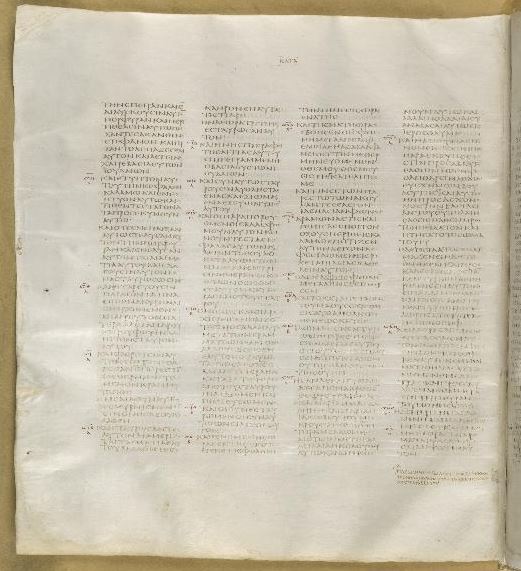
The Books They Took Out: The Apocrypha in the 1611 King James Bible
Scripture
The 1611 King James Bible did not have 66 books. It printed the books called Apocrypha between the Old and New Testaments, and so did the Geneva Bible before it. For more than two hundred years, Protestant English Bibles commonly carried those books. Then a funding rule, locked in at the British and Foreign Bible Society’s annual meetings of 1826 and 1827, stopped Society money from printing or circulating them. The Bible most Protestants were later handed had shrunk from 80 book headings to 66. That is a change. It is not a small one. And it is a change you almost never hear about.
What the 1611 Bible actually contained
You do not have to take a preacher’s word for it. The 1611 edition itself prints a table: “The names and order of all the Bookes of the Olde and New Testament, with the Number of their Chapters.” After Malachi, and before Matthew, it gives a third heading: “The Bookes called Apocrypha.” The list is:
- 1 Esdras
- 2 Esdras
- Tobit
- Judith (Iudeth)
- The rest of Esther
- Wisdom (Wisedome)
- Ecclesiasticus (Sirach)
- Baruch, with the Epistle of Jeremiah
- The Song of the Three Children
- The Story of Susanna
- Bel and the Dragon (The idole Bel and the Dragon)
- The Prayer of Manasseh
- 1 Maccabees
- 2 Maccabees
That table is in the 1611 volume. You can read it on the Christian Classics Ethereal Library’s transcription of the 1611 contents and on Wikisource’s 1611 King James Bible.
Count the headings the way the 1611 table itself counts them. The Old Testament has the familiar 39 books. The Apocrypha section has 14 headings, including the additions to Esther and Daniel as separate items, just as that page lists them. The New Testament has 27. That is 80. Take out the 14, and you have 66. The later “66-book Bible” is not what King James’s printers issued in 1611. It is what remained after those 14 headings were dropped from the book most people were given.
The Geneva Bible had them too
The 1560 Geneva Bible, the English Bible of the Reformation underground and of many early American readers, also printed an Apocrypha section between the Testaments. Its list is nearly the same: 1 and 2 Esdras, Tobit, Judith, the rest of Esther, Wisdom, Ecclesiasticus, Baruch, the Song of the Three Children, Susanna, Bel and the Dragon, and 1 and 2 Maccabees. The Geneva placed the Prayer of Manasseh after 2 Chronicles rather than in that Apocrypha section. The table of contents is on Wikisource’s Geneva Bible page. Later Geneva printings, including some issued under a 1599 title, often omitted the section. That later omission is part of the same shrinking, not proof that the first Geneva never had the books.
The Church of England said: read them, but not as doctrine
The Church of England did not pretend the books were not there. Article VI of the Thirty-Nine Articles, “Of the Sufficiency of the holy Scriptures for salvation,” printed in the 1662 Book of Common Prayer, lists the same books and then draws a line, citing Jerome (spelled “Hierome” in the Article):
“And the other Books (as Hierome saith) the Church doth read for example of life and instruction of manners; but yet doth it not apply them to establish any doctrine; such are these following: The Third Book of Esdras, The Fourth Book of Esdras, The Book of Tobias, The Book of Judith, The rest of the Book of Esther, The Book of Wisdom, Jesus the Son of Sirach, Baruch the Prophet, The Song of the Three Children, The Story of Susanna, Of Bel and the Dragon, The Prayer of Manasses, The First Book of Maccabees, The Second Book of Maccabees.”
Church of England, Thirty-Nine Articles, Article VI, in the 1662 Book of Common Prayer. Official Church of England page: Articles of Religion. Full text: Anglican Church of Canada; also Philip Schaff, The Creeds of Christendom, vol. 3, CCEL.
That is not NCAY’s rule. It is the Church of England’s own rule, in its own confession: these books were to be read, and they were not to be used to build doctrine. The later habit of simply leaving them out of the volume goes further than Article VI ever did.
Rome kept many, and made them doctrine
The Council of Trent, Fourth Session, 8 April 1546, did the opposite of Article VI. It received Tobias, Judith, Wisdom, Ecclesiasticus, Baruch, and the two books of the Maccabees as canonical Scripture, “entire with all their parts,” as in the old Latin Vulgate, and it added an anathema:
“But if any one receive not, as sacred and canonical, the said books entire with all their parts, as they have been used to be read in the Catholic Church, and as they are contained in the old Latin vulgate edition; and knowingly and deliberately contemn the traditions aforesaid; let him be anathema.”
Council of Trent, Fourth Session, Decree Concerning the Canonical Scriptures, 8 April 1546. papalencyclicals.net
Be exact about the lists. Rome kept many of these books, not all of the 1611 headings. Trent’s Old Testament list includes Tobias, Judith, Wisdom, Ecclesiasticus, Baruch, and 1 and 2 Maccabees. It does not list 1 and 2 Esdras (the Third and Fourth Books of Esdras in Article VI) or the Prayer of Manasseh as canonical. The ordinary Catholic count is 73 books, not 80. The point still stands: Rome kept a large part of this literature and raised it to the level of doctrine. Later Protestant mass editions dropped the section from the book itself.
How a funding rule made the 66-book Bible the normal one
The British and Foreign Bible Society was founded in 1804 to circulate the Scriptures as widely and as cheaply as it could. From early on it did not issue English Bibles with the Apocrypha. The fight that changed the ordinary Protestant Bible was over money: whether Society funds could pay for foreign Bibles that still included those books, as the churches on the Continent often required.
William Canton, in the Society’s own official history, prints the record. After years of argument, a Special Committee followed the view of the Society’s president, Lord Teignmouth. On 21 November 1825 the General Committee adopted this resolution:
“That the funds of the Society be applied to the printing and circulation of the Canonical Books of Scripture, to the exclusion of those Books and parts of Books, which are usually termed Apocryphal; and that all copies printed, either entirely or in part, at the expense of the Society, and whether such copies consist of the whole or of any one or more of such Books, be invariably issued bound; no other Books whatever being bound with them: and further, that all money grants to Societies and individuals be made only in conformity with the principle of this regulation.”
William Canton, A History of the British and Foreign Bible Society, vol. 1 (London: John Murray, 1904), p. 341. archive.org/details/britishbiblesoc01cantuoft
Canton then records what followed. “Regulations were drawn up on the basis of the resolution, and adopted at the annual general meetings in 1826 and 1827.” Those rules, later printed in the yearly reports as part of the Society’s fundamental laws, include these:
“I. That the fundamental law of the Society, which limits its operations to the circulation of the Holy Scriptures, be fully and distinctly recognised as excluding the circulation of the Apocrypha.
II. That, in conformity to the previous Resolution, no pecuniary aid can be granted to any Society circulating the Apocrypha; nor, except for the purpose of being applied in conformity to the said Resolution, to any individual whatever.
III. That in all cases in which grants, whether gratuitous or otherwise, of the Holy Scriptures, either in whole or in part, shall be made to any Society, the books be issued bound, and on the express condition that they shall be distributed without alteration or addition.”
Canton, History, vol. 1, pp. 341–42. In 1827 a fourth rule was added, requiring that even grants to societies which still circulated the Apocrypha be sold or distributed “without alteration or addition,” with the proceeds held at the Society’s disposal.
Lord Teignmouth, who chaired the annual meeting on 3 May 1826, wrote afterwards in a letter that Canton prints: “The resolutions respecting the Apocrypha were introduced in the very beginning of the Report, as bearing more particularly on the foreign Societies. They were received with acclamations.” Secondary writers sometimes date the “funds of the Society” sentence itself to 1826. The Society’s own historian places that wording in the General Committee on 21 November 1825, and the binding public regulations at the 1826 and 1827 annual meetings. The result is the same: Society money would no longer fund Bibles that included the books called Apocrypha, and no Society aid would go to anyone who circulated them.
That policy helped make the 66-book Bible the normal Protestant Bible, in English and in mission work. Other printers could still issue a King James with the Apocrypha. The cheap, widely scattered Bible most people actually received no longer had the section.
They still matter, if you read them as witnesses
NCAY INC does not receive these books as a second canon on which to build doctrine. We also will not pretend they were never in the English Bible, or that they are worthless because later societies stopped paying to print them. They are witnesses. They should be read critically, and in the earliest text that can be had — not only in a late English page, and not only in a Latin church edition.
Some of that earlier text has survived. Hebrew of Sirach (Ecclesiasticus) has come down in the Cairo Genizah and at Masada, with additional fragments among the Dead Sea Scrolls. Tobit has been found at Qumran in Aramaic and in Hebrew. These are not Catholic inventions of the sixteenth century. They are older Jewish literature, and they should be read as such.
Read 1 Maccabees and see men who would not forsake the law when a king commanded them to. Mattathias answered the officers at Modin:
“Though all the nations that are under the king’s dominion obey him, and fall away every one from the religion of their fathers, and give consent to his commandments: Yet will I and my sons and my brethren walk in the covenant of our fathers. … We will not hearken to the king’s words, to go from our religion, either on the right hand, or the left.”
1 Maccabees 2:19–20, 22, King James Version. 1 Maccabees 2
Read 2 Maccabees 7, the mother and her seven sons, who would rather die than eat what the law forbade. One of them, at the last gasp, said, “Thou like a fury takest us out of this present life, but the King of the world shall raise us up, who have died for his laws, unto everlasting life.” 2 Maccabees 7:9, King James Version. 2 Maccabees 7. This is one of the witnesses that was taken off the kitchen table.
Read Wisdom on idolatry, and see how plainly it cuts:
“Surely vain are all men by nature, who are ignorant of the Eternal, and could not out of the good things that are seen know him that is: neither by considering the works did they acknowledge the workmaster; But deemed either fire, or wind, or the swift air, or the circle of the stars, or the violent water, or the lights of heaven, to be the gods which govern the world.”
Wisdom of Solomon 13:1–2, King James Version, with “God” for the Creator written “the Eternal” per NCAY practice. Wikisource, Wisdom of Solomon
Sirach (Ecclesiasticus) is a book of instruction in the fear of YHVH and in the keeping of His ways. It is Jewish wisdom, not a later church tract. Read it. Compare it with the Hebrew where the Hebrew can be had. Do not let either Rome’s anathema or a Bible society’s funding rule tell you whether a witness may be heard.
The hush is the point
Until recently, a man who asked whether the Bible had changed was often handed a single answer: no, not in any way that matters. The 1611 volume on the shelf, with the Apocrypha between the Testaments, was left out of the story. So was the Geneva Bible. So was Article VI. So was the Society vote that cut off the money. The smaller book became “the Bible,” and the memory of the larger one was allowed to fade.
YHVH has not hidden Himself. “Hear, O Israel: YHVH our Eternal, YHVH is one.” Deuteronomy 6:4, Jewish Publication Society Tanakh, 1917, names per NCAY practice. The question is whether men will search what was in the book, or take the funnel. These writings are not the Torah, and they are not the Prophets. They are witnesses, some of them precious, and they were in the English Bible your fathers were given. Read them. Test them. Do not let anyone tell you they were never there.
Sources
- The 1611 King James contents table, “The Bookes called Apocrypha”: ccel.org/bible/kjv/preface/ordbk.htm; Wikisource, Bible (King James Version, 1611).
- The 1560 Geneva Bible table of contents, with the Apocrypha between the Testaments: Wikisource, Bible (Geneva).
- Church of England, Thirty-Nine Articles, Article VI, in the 1662 Book of Common Prayer: churchofengland.org, Articles of Religion; full text at the Anglican Church of Canada and in Philip Schaff, The Creeds of Christendom, vol. 3, CCEL.
- Council of Trent, Fourth Session, 8 April 1546, Decree Concerning the Canonical Scriptures: papalencyclicals.net.
- William Canton, A History of the British and Foreign Bible Society, vol. 1 (London: John Murray, 1904), chap. 17, “The Apocrypha Controversy,” especially pp. 336–42 (21 November 1825 General Committee resolution, p. 341; regulations adopted at the 1826 and 1827 annual meetings, pp. 341–42; Lord Teignmouth on the 3 May 1826 meeting, p. 342). archive.org/details/britishbiblesoc01cantuoft.
- Scripture and Apocrypha quotations: Deuteronomy 6:4, Jewish Publication Society Tanakh, 1917 (public domain), with the Name written YHVH and “God” written “Eternal”; 1 Maccabees 2:19–20, 22; 2 Maccabees 7:9; Wisdom of Solomon 13:1–2, King James Version (public domain), with “God” for the Creator written “the Eternal” per NCAY practice.
