
The Last Twelve Verses of Mark Were Added Later
Scripture
Many printed Bibles still run Mark’s account through 16:20. The earliest Greek manuscripts we have of the end of Mark do not. The longer ending, Mark 16:9–20, is a later addition. That is not a rumor, and it is not a minor footnote. It is the manuscript evidence, and we will not build our practice on those added verses.
What the oldest copies do
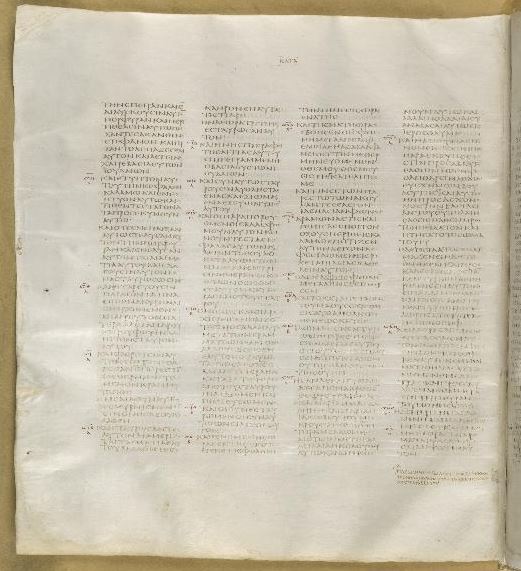
The two oldest complete Greek Bibles that contain Mark, Codex Sinaiticus and Codex Vaticanus (both fourth century), end Mark at 16:8, with the women fleeing the tomb and saying nothing to anyone, “for they were afraid.” Bruce M. Metzger, in his Textual Commentary on the Greek New Testament, records that the last twelve verses of the commonly received text are also absent from the Old Latin Codex Bobiensis, the Sinaitic Syriac, about a hundred Armenian manuscripts, and the two oldest Georgian manuscripts. He adds that Clement of Alexandria and Origen show no knowledge of those verses, and that Eusebius and Jerome attest that the passage was absent from almost all Greek copies of Mark known to them.
Some later copies add a short ending after 16:8: a brief report to Peter and a general commission to preach. Most of those witnesses then go on to include 16:9–20 as well. Still later, the traditional longer ending became the text of the majority of medieval manuscripts and of the King James Version.
The longer ending was already known in the second century: Irenaeus quotes Mark 16:19, and it appears in the Diatessaron. Antiquity of a passage is not the same as originality. Metzger judged the vocabulary and style of 16:9–20 to be non-Markan, the join at verse 9 to be awkward, and the section likely excerpted from another document, perhaps from the first half of the second century. His conclusion: “On the basis of good external evidence and strong internal considerations it appears that the earliest ascertainable form of the Gospel of Mark ended with Mark 16:8.” The editors still printed 16:9–20 in double brackets, to show that they are “the work of an author other than the evangelist.”
Why it matters
The added verses include appearances after the resurrection, a commission to preach, and signs such as picking up serpents and drinking poison without harm (16:18). Those lines have been used to build practices the earlier form of Mark does not teach. We will not treat snake-handling, poison-drinking, or any other rite drawn from 16:9–20 as a command of Scripture. We are to prove all things. A later ending, however old, is not a license to treat every word in a printed column as if it came from the same hand as Mark 16:8.
This is not an attack on the hope of the resurrection. It is a call to read the text as it actually comes down to us, and to refuse to build doctrine on an addition.
Sources
- Bruce M. Metzger, A Textual Commentary on the Greek New Testament, comments on Mark 16:9–20.
- Codex Sinaiticus and Codex Vaticanus (fourth century), ending Mark at 16:8.
- Eusebius, questions to Marinus, and Jerome, Letter 120 to Hedibia, on copies that ended at 16:8 (discussed in Metzger and in later textual studies).


